
Comprehensive LC-HRMS Characterization of Formulation-Related Impurities in Tirzepatide + Vitamin B12 Formulations
news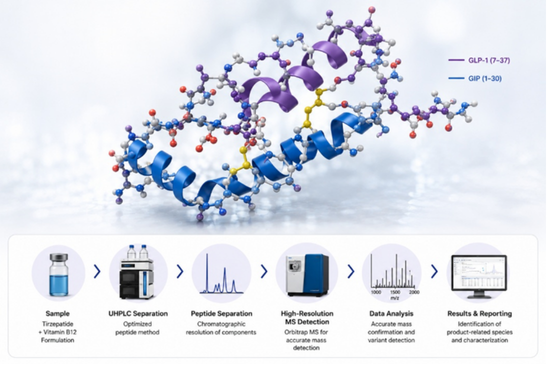
Tirzepatide is a synthetic 39-amino acid therapeutic peptide that functions as a dual glucose-dependent insulinotropic polypeptide (GIP) and glucagon-like peptide-1 (GLP-1) receptor agonist for treatment of type 2 diabetes and obesity. As with many peptide therapeutics, its complex molecular structure contains chemically labile amino acid residues that are susceptible to degradation during manufacturing, formulation, storage, transport, and handling. Common degradation pathways include oxidation, deamidation, hydrolysis, isomerization, peptide truncation, aggregation, and formulation-associated modifications. These molecular changes may alter potency, stability, pharmacokinetic behavior, and immunogenicity and are therefore regarded as critical quality attributes (CQAs) that require careful analytical monitoring throughout formulation development, stability testing, process optimization, lot release, and comparability studies.
Tirzepatide formulations containing cyanocobalamin (Vitamin B12) have become increasingly available. The additional formulation components, excipients, compounding processes, and storage conditions may introduce impurities or accelerate degradation pathways that are absent in pharmaceutical reference standards. While reversed-phase HPLC provides excellent chromatographic separation, retention time alone cannot establish molecular identity. High-resolution Mass Spectrometry (HRMS) combines chromatographic separation with accurate mass measurements and high resolving power, enabling simultaneous confirmation of the intact peptide and comprehensive characterization of low-level formulation-related impurities using a single analytical platform.